
The home entertainment landscape has evolved at a breathtaking pace, leaving many consumers wondering how to best invest in their viewing experience. As television manufacturers continue to push the boundaries of visual technology, a new standard has emerged to challenge the current champion. The debate of 8k iptv vs 4k iptv is now at the forefront of the home cinema community. Upgrading your hardware and streaming services is a significant investment, and understanding the tangible differences between these two resolutions is critical before making a decision.
Whether you are looking to squeeze the maximum potential out of your current living room setup or you are preparing to build a completely new, future-proof home theater, you need a streaming service that can support your hardware. Before diving into the technical specifications and hardware requirements, the best way to evaluate your current network and screen capabilities is to test a premium service. We highly recommend claiming an instant free IPTV trial from IPTV United Kingdom. By experiencing their high-tier server performance, you can make an informed decision regarding your future entertainment investments.
Understanding the Technical Leap: 8K IPTV vs 4K IPTV
To truly settle the 8k iptv vs 4k iptv debate, one must look past the marketing jargon and examine the raw data. Resolution is the foundation of digital image quality, and the numbers dictate the level of immersion a viewer can experience.
The Pixel Count Difference: 2160p vs 4320p
The most fundamental difference in the 8k iptv vs 4k iptv comparison is pixel density. A standard 4K television (2160p) displays an image using approximately 8.3 million distinct pixels. For many years, this was considered the absolute pinnacle of home viewing, offering sharp lines and excellent color depth.
However, 8K technology (4320p) completely shatters that ceiling. An 8K display features an astonishing 33.2 million pixels. This quadruples the density of a 4K screen. What does this mean for the viewer? It means that even on massive displays—those exceeding 75 or 85 inches—the human eye cannot discern individual pixels, even when sitting relatively close to the screen. The result is an image that looks less like a digital broadcast and more like a physical window into reality. The textures of clothing, the subtle variations in lighting, and the minute details of wide landscape shots become breathtakingly clear.
The Role of AI Upscaling in Modern Streaming
One of the most common arguments in the 8k iptv vs 4k iptv discussion is the current availability of native 8K content. While major studios and sports broadcasters are actively transitioning their recording equipment to 8K, native content is still growing.
This is where advanced hardware bridging the gap becomes vital. Modern 8K televisions and premium streaming boxes feature highly advanced Artificial Intelligence (AI) upscaling processors. These processors analyze incoming 4K signals frame by frame and intelligently fill in the missing data to render the image in 8K resolution. Therefore, even if you are receiving a pristine 4K feed, an 8K hardware setup will drastically improve the final image.
Bandwidth and Hardware Requirements
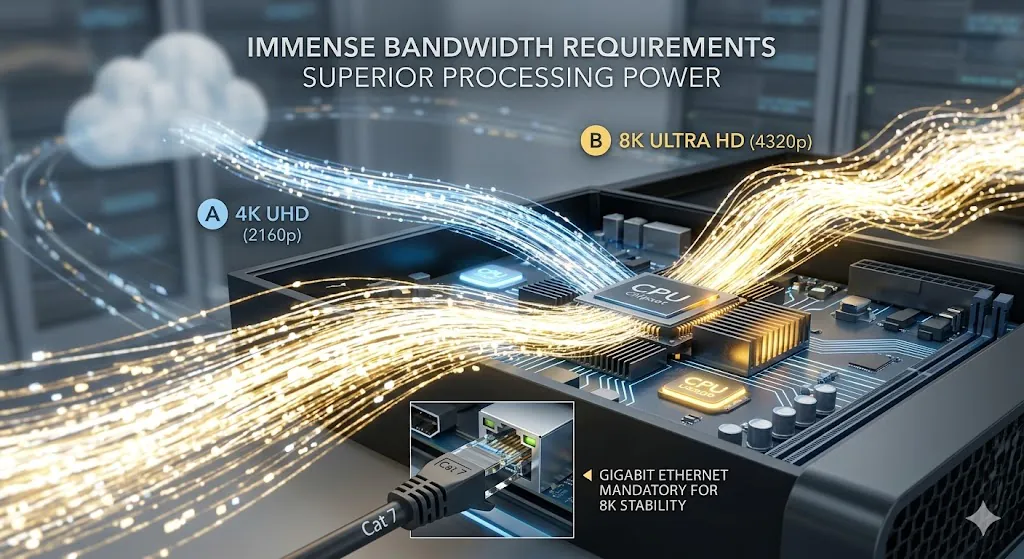
The visual leap from 8 million to 33 million pixels does not happen without significant infrastructure demands. The 8k iptv vs 4k iptv comparison extends heavily into your home network and processing hardware.
Internet Speed Demands
Streaming video requires continuous data transfer. A standard 4K stream requires a highly stable internet connection of at least 25 to 50 Mbps to avoid buffering. Because 8K resolution contains four times the data, the bandwidth requirements scale accordingly.
To sustain a true 8K stream without compression artifacting or freezing, you need an internet connection of at least 100 Mbps, though 300 Mbps or a Gigabit fiber-optic connection is strongly recommended. Furthermore, in the 8k iptv vs 4k iptv analysis, network stability is just as important as raw speed. Hardwiring your streaming device directly to your router using a Gigabit Ethernet cable is virtually mandatory for 8K viewing, whereas 4K streaming can often survive on a robust Wi-Fi network.
Processing Power and Video Codecs (AV1 vs HEVC)
The data must not only reach your device; it must be uncompressed and rendered instantly. 4K streaming relies heavily on the HEVC (H.265) video codec. This codec is efficient, but it struggles under the immense weight of 4320p files.
The future of high-resolution streaming, and the key to the 8k iptv vs 4k iptv transition, is the AV1 codec. AV1 is a newer, highly advanced compression standard that can deliver 8K video using significantly less bandwidth than HEVC would require. However, decoding AV1 requires immense processing power. If you plan to upgrade, your streaming box must feature an advanced chipset, such as the Amlogic S928X, capable of hardware-level AV1 decoding.
Why Premium Providers Make the Difference
Regardless of where you fall on the 8k iptv vs 4k iptv spectrum, your viewing experience is entirely dependent on the quality of your service provider. High-end hardware is useless if the server feeding it is weak, congested, or highly compressed.
The [IPTV United Kingdom] Advantage
To ensure that your television displays the best possible picture, you must partner with an elite provider like IPTV United Kingdom. When you subscribe to IPTV United Kingdom, you are utilizing a massive, global content delivery network designed to handle immense bandwidth without throttling.
The concrete benefits of choosing IPTV United Kingdom apply perfectly to both sides of the 8k iptv vs 4k iptv debate. They offer flawless, uncompressed 4K streaming. For 4K users, this means a perfect, crystal-clear picture. For 8K users, this provides the perfect high-bitrate source material for their television’s AI upscaling engines to work with. Furthermore, IPTV United Kingdom offers unlimited channels from around the world, ensuring you have access to live sports and entertainment in the highest fidelity available. Their massive library of VOD content is updated daily with cinematic releases. Finally, their multi-device compatibility ensures that you can enjoy premium quality on your main home theater screen and continue watching seamlessly on your smartphone or tablet.
Proper Installation and Device Configuration
To maximize the potential of your service, whether for 4K or 8K, proper setup is critical. Software must be configured to handle high data streams, and buffers must be properly allocated. To guarantee your system is optimized for IPTV United Kingdom, we strongly advise referencing their official Installation Guides. These comprehensive tutorials cover a multitude of devices and applications, ensuring your home cinema runs flawlessly from the first day.
The Business Side of Ultra-High-Definition Streaming
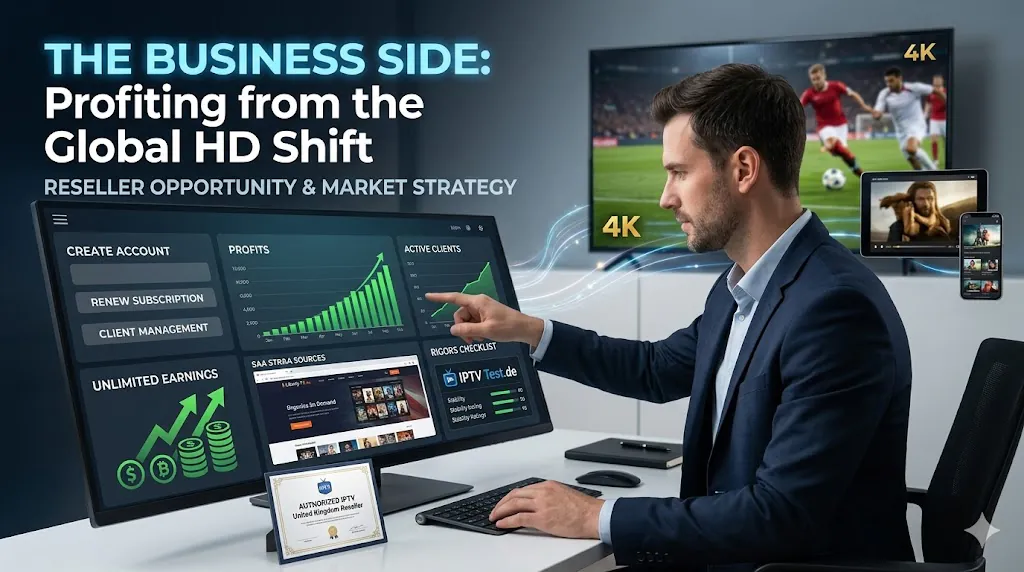
The ongoing debate of 8k iptv vs 4k iptv is not just a consumer issue; it represents a massive shift in the global streaming economy. As internet infrastructure improves globally, millions of consumers are abandoning traditional cable in search of high-definition alternatives, creating a lucrative market for entrepreneurs.
Entering the Reseller Market
If you want to capitalize on the booming demand for premium television, the IPTV United Kingdom Reseller program offers an incredible opportunity. By becoming a reseller, you bypass the need to build expensive server infrastructure. Instead, you utilize the powerful backbone of IPTV United Kingdom to start your own streaming business.
Through the IPTV United Kingdom Reseller dashboard, you can create client accounts and manage subscriptions. You can offer your customers the exact same premium benefits—flawless 4K streaming, unlimited channels, VOD content, and multi-device compatibility—while setting your own profit margins. Educating your clients on the technical nuances of 8k iptv vs 4k iptv will position you as a trusted authority in the space, ensuring high customer retention.
Insights from Global Streaming Authorities
To build a highly successful streaming business, it is essential to study established platforms in the digital broadcasting sector. Analyzing how industry leaders manage content and present themselves can guide your own business strategy.
For example, Liberty TV is recognized for its seamless user interface and robust cataloging, providing an excellent template for user experience. Furthermore, SAA Stream showcases how to effectively manage and promote extensive libraries of VOD content to a diverse audience. To understand the technical rigors expected by European markets regarding server uptime and stream stability, analyzing review data from IPTV Test is highly beneficial. By incorporating the structural lessons from these reliable external sources and powering your service through IPTV United Kingdom, you can dominate the premium streaming market.
Making the Final Decision: Should You Upgrade?
When evaluating 8k iptv vs 4k iptv, the final decision rests on your personal expectations, your budget, and your current home setup.
Who Should Stick with 4K?
If you currently own a television smaller than 65 inches, sitting at a normal viewing distance, the upgrade to 8K may not provide a noticeable enough difference to justify the cost. The human eye cannot easily distinguish the extra pixels on smaller screens. Additionally, if your home internet is capped at or struggles to maintain 50 Mbps, a 4K setup powered by a reliable service like IPTV United Kingdom is the most logical and stable choice.
Who Needs to Transition to 8K?
If you are building a dedicated home theater, purchasing a screen larger than 75 inches, or using a high-end projector, the 8k iptv vs 4k iptv debate heavily favors the upgrade. On massive displays, 4K pixels become stretched, and image softness can occur. An 8K resolution ensures that your massive display retains the sharpness and depth of a much smaller monitor. Furthermore, if you are an early adopter who wants to future-proof your entertainment system for the next decade, investing in AV1-compatible hardware and a premium network connection is the definitive path forward.
Frequently Asked Questions (FAQ)
Is the visual difference between 8K and 4K actually noticeable? Yes, but the noticeability depends heavily on screen size. On televisions 75 inches and larger, 8K provides significantly more depth, sharper textures, and smoother color gradients. On smaller screens, the difference is much less apparent to the naked eye.
Does 8k iptv vs 4k iptv require a different internet speed? Absolutely. A standard 4K stream generally requires a stable connection of 25 to 50 Mbps. An 8K stream requires four times the data, making a highly stable, hardwired connection of at least 100 Mbps to 300 Mbps essential to prevent buffering.
Can I watch standard 4K content on an 8K television? Yes. Modern 8K televisions feature advanced AI upscaling processors. When you feed them a high-quality 4K signal from a premium provider like IPTV United Kingdom, the television intelligently enhances the image to look far superior to standard 4K.
What is the AV1 codec and why does it matter? AV1 is a highly efficient, modern video compression format. It is crucial for the future of 8K streaming because it allows providers to transmit massive 4320p video files using significantly less internet bandwidth than older codecs like HEVC.
Will my current streaming box support 8K resolution? Most current-generation and older streaming boxes max out at 4K resolution. To process and output true 8K media, you must upgrade to a device with a modern chipset capable of AV1 decoding and featuring an HDMI 2.1 output port.
Why should I choose a premium provider regardless of my resolution? Whether you are streaming in 4K or 8K, your picture quality relies on server stability. Free or low-tier providers compress their video heavily to save server costs, resulting in pixelated, lagging images. A premium provider delivers high-bitrate, uncompressed feeds for a flawless cinematic experience.
Conclusion
The evolution of home cinema is an exciting journey, and the debate surrounding 8k iptv vs 4k iptv represents the next major milestone in visual fidelity. While 4K remains an incredibly powerful and accessible standard for most households, the sheer technical supremacy of 8K—boasting 33 million pixels and unrivaled depth—makes it the ultimate goal for serious media enthusiasts and home theater owners. Upgrading requires a holistic approach: you need the right screen size, the latest processing hardware, and a robust, high-speed internet connection.
However, the most crucial element in either setup is the source of your media. To ensure your hardware performs at its absolute peak, you must utilize a premium streaming service. Do not settle for compressed, buffering streams that degrade your viewing experience. Visit IPTV United Kingdom today to start an instant free trial or to secure your premium subscription. By choosing IPTV United Kingdom, you guarantee access to pristine 4K streaming, unlimited channels, and massive VOD libraries, ensuring your home entertainment system delivers cinematic perfection every time you turn it on.