
The landscape of digital television and streaming is evolving at an unprecedented pace. Just as audiences have grown accustomed to the crisp clarity of 4K resolution, the industry is already pushing the boundaries toward 8K. However, delivering such a massive amount of visual data over the internet presents a significant technological hurdle. The solution lies in advanced video compression algorithms. For those analyzing the technical requirements of next-generation streaming, understanding the dynamics of h.265 vs h.266 for 8k iptv is absolutely critical.
This comprehensive guide will explore the fundamental differences between these two powerful codecs, how they manage bandwidth, and why upgrading your underlying technology is essential for the future of home entertainment. If you are looking to experience premium streaming quality today without the buffering, you can discreetly start an instant free trial at IPTV United Kingdom, a service designed to maximize the potential of modern video codecs.
Understanding the Basics of Video Compression
Before diving into the direct comparison of h.265 vs h.266 for 8k iptv, it is important to establish how video compression works and why it is the backbone of the streaming industry. Raw video files, especially at ultra-high definitions, contain an astronomical amount of data. Sending this raw data over standard broadband connections is impossible. Codecs (coder-decoders) compress this data at the source and decompress it on your television or media player, removing redundant information while preserving visual fidelity.
What is H.265 (HEVC)?
H.265, also known as High Efficiency Video Coding (HEVC), is the current industry standard for high-resolution video streaming. Introduced in 2013 as the successor to H.264, HEVC revolutionized the delivery of 4K content. It achieved this by utilizing Coding Tree Units (CTUs) that can process blocks up to 64×64 pixels, a massive upgrade from the 16×16 macroblocks used by its predecessor.
This architectural shift allowed H.265 to deliver the exact same visual quality as H.264 while using approximately 50 percent less bandwidth. Without H.265, the widespread adoption of 4K streaming would have stalled due to network infrastructure limitations. Today, it remains the dominant force behind most high-quality IPTV services.
What is H.266 (VVC)?
H.266, or Versatile Video Coding (VVC), is the cutting-edge successor to HEVC, officially finalized in 2020. Developed specifically with the monumental data requirements of 4K, 8K, and 360-degree video in mind, VVC represents the next frontier in digital transmission.
H.266 builds upon the foundation of HEVC but introduces highly sophisticated algorithms, including improved intra-prediction, advanced motion compression, and larger partition sizes (up to 128×128 pixels). The primary objective of H.266 is to halve the bitrate requirements of H.265 without sacrificing a single pixel of visual quality. This makes the debate of h.265 vs h.266 for 8k iptv a central topic for broadcasting engineers and streaming enthusiasts alike.
h.265 vs h.266 for 8k iptv: The Ultimate Showdown
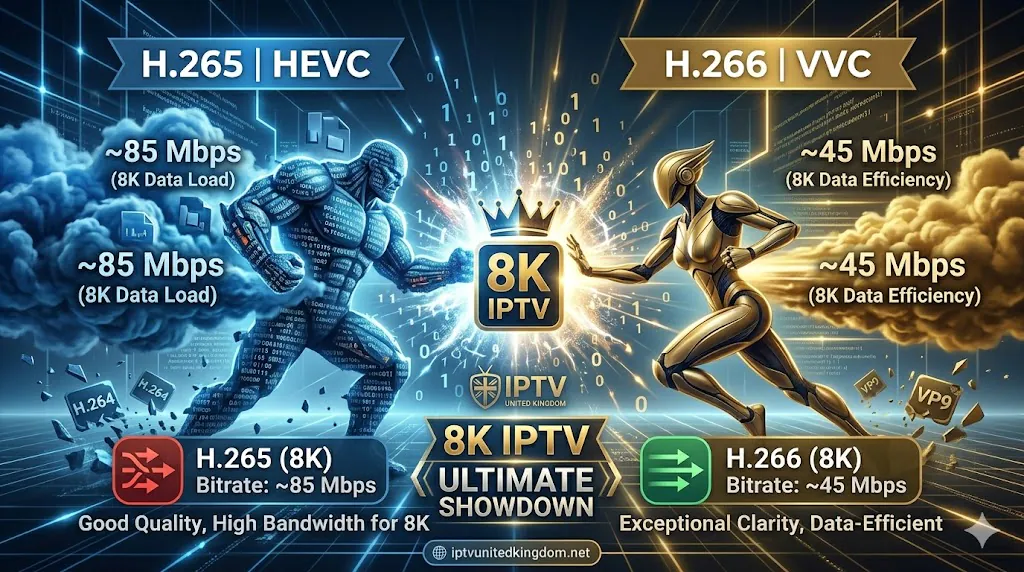
When evaluating h.265 vs h.266 for 8k iptv, the comparison comes down to three critical metrics: bandwidth efficiency, quality retention, and hardware processing requirements.
Bandwidth and Bitrate Savings
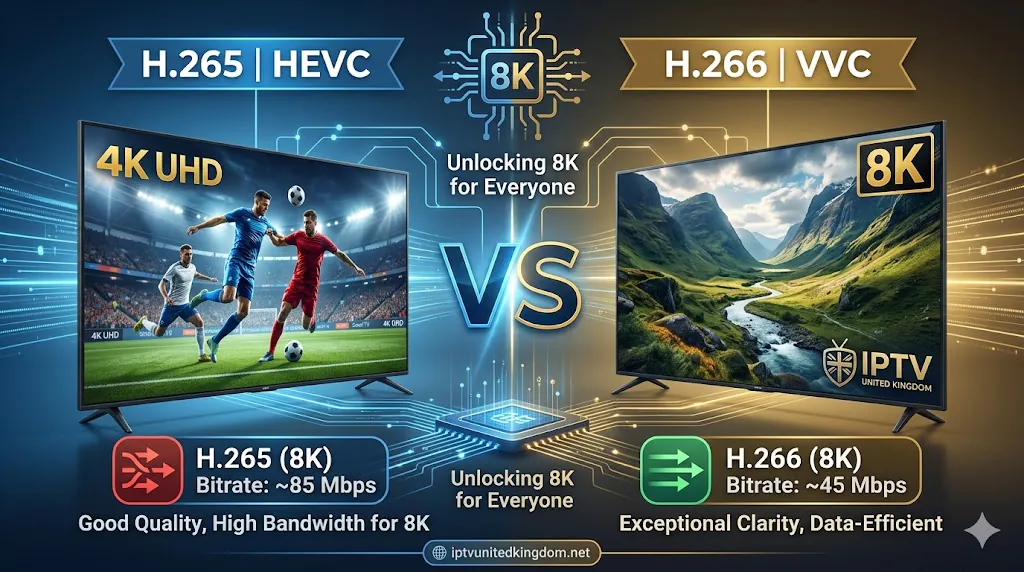
The most significant advantage in the h.265 vs h.266 for 8k iptv conversation is data reduction. 8K resolution contains four times the number of pixels as 4K, resulting in massive files. A standard 8K stream encoded in H.265 generally requires a continuous internet connection speed of roughly 80 to 85 Mbps. For the average household, sustaining this speed without network fluctuation is incredibly difficult, leading to buffering and dropped frames.
H.266 changes the equation entirely. By achieving an additional 40 to 50 percent reduction in bitrate compared to H.265, VVC can deliver a flawless 8K stream at approximately 40 to 45 Mbps. This mathematical advantage is the exact reason why h.265 vs h.266 for 8k iptv heavily favors the newer codec for future network scalability. It dramatically lowers the barrier to entry for ultra-high-definition streaming, ensuring that more users can access premium content on standard broadband connections.
Quality and Resolution Retention
Compression naturally involves the removal of data, but the goal of a premium codec is to make this loss imperceptible to the human eye. In the context of h.265 vs h.266 for 8k iptv, VVC employs an expanded suite of 81 intra-prediction modes (compared to HEVC’s 35). This allows the H.266 codec to more accurately predict and render fine details, complex textures, and rapid motion.
Whether you are watching a high-speed sports broadcast or a visually complex cinematic landscape, H.266 ensures that the high dynamic range (HDR), wide color gamut, and structural integrity of the 8K image are preserved immaculately. Tests utilizing the Video Multimethod Assessment Fusion (VMAF) metric consistently show that H.266 maintains or exceeds the perceptual quality of H.265 while consuming half the data.
Hardware and Decoding Requirements
The remarkable efficiency of H.266 comes at a computational cost. The algorithms that allow for such extreme data compression require significantly more processing power to encode and decode. Currently, encoding H.266 can be up to ten times more complex than H.265, and decoding requires nearly twice the computational effort.
For consumers looking at h.265 vs h.266 for 8k iptv, this means that legacy hardware will not suffice. Decoding an 8K VVC stream requires modern, purpose-built processors or dedicated graphics processing units capable of hardware-accelerated decoding. While H.265 is currently supported by nearly every smart TV and streaming stick on the market, H.266 requires the next generation of media players to function smoothly.
Why H.266 is the Future of 8K IPTV Streaming
The transition from H.265 to H.266 is not merely an incremental upgrade; it is a fundamental necessity for the evolution of the Internet Protocol Television (IPTV) industry.
The Data Challenge of 8K Content
As television manufacturers push 8K displays into the mainstream market, content providers are pressured to supply native 8K media. However, internet service providers (ISPs) enforce data caps and throttle bandwidth to manage network loads. Relying on H.265 for widespread 8K distribution would instantly congest global networks. Therefore, analyzing h.265 vs h.266 for 8k iptv reveals that VVC is the only sustainable pathway. It acts as a pressure valve, allowing content delivery networks to distribute massive files without collapsing under the bandwidth strain.
Smoothing Out Network Congestion
Even if a viewer does not have an 8K television, the implementation of H.266 benefits the entire ecosystem. Because VVC compresses 4K and 1080p streams more efficiently than HEVC, it frees up overall network bandwidth. This translates to fewer buffering instances during peak viewing hours, faster channel zapping times, and a generally more stable streaming environment for everyone connected to the server.
Elevate Your Viewing with IPTV United Kingdom
While the global rollout of 8K and H.266 continues to mature, you can experience the absolute pinnacle of current streaming technology right now. By choosing a premium provider, you guarantee access to servers optimized for the best available codecs, ensuring pristine delivery of your favorite media. This is where IPTV United Kingdom excels.
4K Streaming and Beyond
IPTV United Kingdom utilizes highly optimized servers and advanced compression techniques to deliver breathtaking 4K UHD streaming. By maximizing the capabilities of current high-efficiency codecs, the service ensures that you receive crystal-clear imagery, deep contrasts, and vibrant colors without the constant interruption of buffering wheels.
Unlimited Channels and VOD Library
A superior codec is only as good as the content it delivers. IPTV United Kingdom offers an expansive, unlimited selection of live premium channels spanning sports, news, documentaries, and international networks. Furthermore, their massive Video on Demand (VOD) library is meticulously updated, providing you with instant access to the latest cinematic releases and binge-worthy television series, all encoded for maximum visual fidelity and minimal bandwidth consumption.
Multi-Device Compatibility
Modern entertainment requires flexibility. Whether you are watching on a flagship Smart TV in your living room, a laptop while traveling, or a smartphone during your commute, IPTV United Kingdom provides flawless multi-device compatibility. Their service adapts seamlessly to your hardware, ensuring that the video stream is perfectly optimized for the screen you are using. To see the difference for yourself, visit IPTV United Kingdom today and elevate your home entertainment setup.
How to Prepare Your Setup for the Next Generation of IPTV
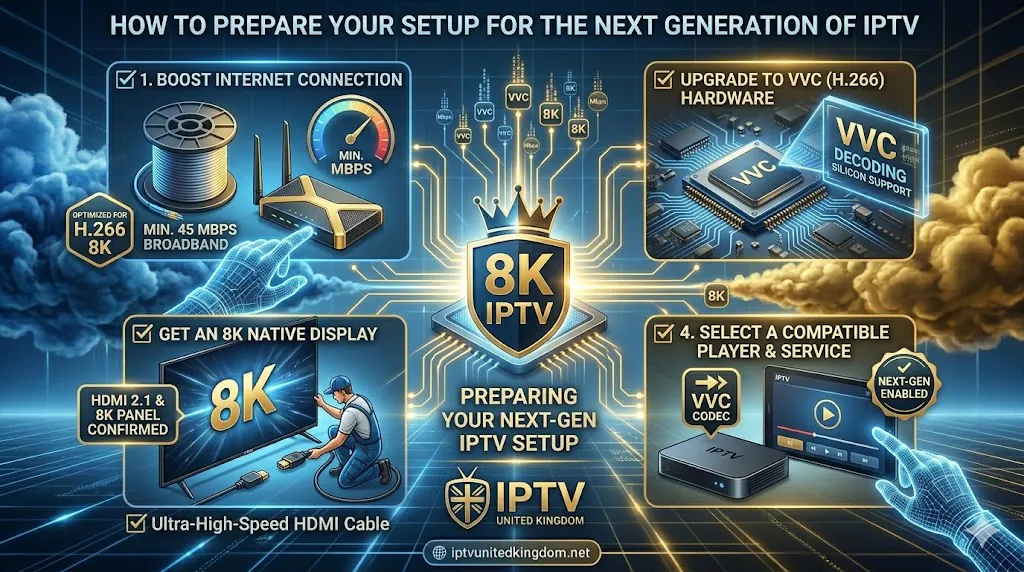
Understanding the nuances of h.265 vs h.266 for 8k iptv is only the first step. To fully capitalize on the future of streaming, you must ensure that your home network, hardware, and service providers are aligned with these emerging standards.
Upgrading Your Hardware
To process the intense computational load of H.266, hardware acceleration is mandatory. When purchasing your next Smart TV, Android box, or streaming stick, look specifically for “VVC hardware decoding” or “H.266 support” in the technical specifications. Attempting to decode VVC via software on an older processor will result in severe stuttering, overheating, and unwatchable frame rates. Furthermore, ensure your internet router is Wi-Fi 6 capable or utilize a direct ethernet connection to handle the sustained bandwidth required for uninterrupted high-resolution viewing.
Choosing the Right Provider
The technology running on your television is ultimately dependent on the source providing the stream. Partnering with a forward-thinking provider is crucial. For those interested in understanding how premium services are deployed, the Installation Guides provided by IPTV United Kingdom offer excellent, step-by-step instructions for optimizing your setup across various devices.
Additionally, for tech-savvy entrepreneurs looking to capitalize on the growing demand for high-quality streaming, exploring the IPTV United Kingdom Reseller program provides a lucrative opportunity to distribute premium, well-encoded content to a broader audience.
Industry Adoption and Timelines
The integration of H.266 into the mainstream market is a gradual process. Hardware manufacturers, software developers, and broadcasting networks must all synchronize their efforts. Renowned tech platforms consistently monitor this progression. For instance, industry experts at Liberty TV often highlight how the transition to newer codecs reshapes global broadcasting standards. Similarly, streaming analysis sites like SAA Stream and rigorous testing environments such as IPTV Test frequently measure the real-world performance gains achieved when migrating from HEVC to VVC infrastructures. These authoritative sources confirm that while H.265 remains the current workhorse, H.266 is rapidly becoming the indispensable foundation for tomorrow’s 8K services.
Frequently Asked Questions (FAQ)
To further clarify the topic of h.265 vs h.266 for 8k iptv, here are the most common questions users ask regarding these video compression standards.
What is the main difference between H.265 and H.266? The primary difference is compression efficiency. H.266 (VVC) can compress video files to be approximately 50 percent smaller than H.265 (HEVC) while maintaining the exact same visual quality. This drastic reduction in data size is what makes streaming ultra-high-definition 8K content possible over standard internet connections.
Do I need a new TV to watch H.266 video streams? Yes, in most cases. Because H.266 utilizes highly complex algorithms, decoding the video requires advanced, dedicated hardware processors. Older televisions and streaming devices designed for H.265 will lack the computational power required to smoothly play H.266 content without severe stuttering or hardware failure.
How does H.266 impact my internet data usage? If you are subject to data caps by your Internet Service Provider, H.266 is highly beneficial. By cutting the required bitrate in half compared to older codecs, H.266 allows you to stream double the amount of high-quality video content before reaching your monthly data limits.
Is H.265 going to be obsolete soon? No, H.265 will remain a dominant and highly relevant standard for years to come. It is currently the backbone of global 4K streaming and is supported by billions of devices worldwide. H.266 will slowly phase into the market specifically for 8K distribution, but HEVC will comfortably handle 1080p and 4K content for the foreseeable future.
Why does 8K IPTV require H.266 instead of just using H.265? 8K video contains four times the pixel density of 4K video, resulting in colossal data files. If 8K were streamed using H.265, it would require internet speeds of 80+ Mbps, which is inaccessible for many and would congest ISP networks. H.266 compresses that data down to a manageable 40 Mbps, making 8K streaming viable.
Can I get a premium IPTV service right now that offers flawless high-definition streaming? Absolutely. You can access highly optimized servers providing 4K content, vast VOD libraries, and multi-device support by visiting IPTV United Kingdom. They utilize advanced streaming technologies to ensure you receive a buffer-free, crystal-clear entertainment experience.
Conclusion
The evolution of broadcast media is an unending race toward visual perfection. When assessing h.265 vs h.266 for 8k iptv, the conclusion is clear: while H.265 laid the critical groundwork that made 4K streaming a global reality, H.266 is the undeniable future. By achieving a staggering 50 percent reduction in bandwidth requirements, VVC solves the massive data challenges presented by 8K resolution, ensuring that the next generation of visual fidelity remains accessible, smooth, and breathtakingly detailed.
Understanding the technical aspects of h.265 vs h.266 for 8k iptv prepares you for the upcoming hardware shift and allows you to optimize your current home network. You do not need to wait for the future to enjoy a premium, theater-quality viewing experience in your own living room today. Take advantage of industry-leading streaming technology, unlimited premium channels, and an expansive VOD library right now. Visit IPTV United Kingdom to start a free trial or subscribe, and immediately transform the way you experience television.